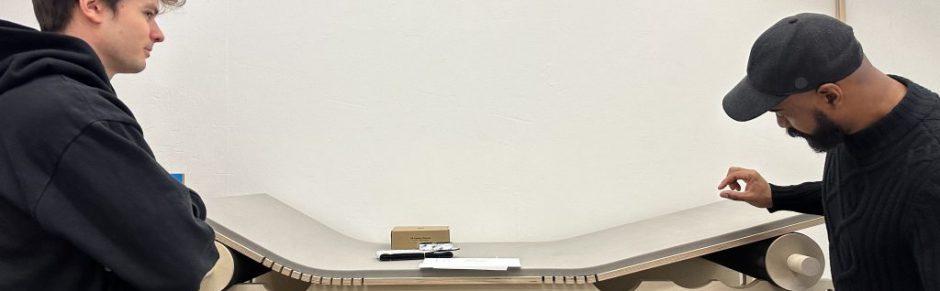
Blog Post 3: Design Sprint Mini Show
Introduction
In Week 3 of this academic year, I co-designed and facilitated a “Design Sprint Mini Show” for Stage 3 design students at Central Saint Martins. This event marked the culmination of a three-week student-led orientation and project positioning phase, where students developed initial hypotheses for their major projects. Taking place in the public space of the CSM Street, the Mini Show invited students to visually and verbally present their developing project ideas to an audience of design tutors, contextual studies lecturers, peers, and passers-by. My role was central in embedding this event into the curriculum – I wanted an early showcase that would serve as a formative checkpoint for students’ projects, assisting them in grounding their initial position and giving them more agency when starting their reading, research, positioning and direction of travel.
The rationale behind the Mini Show was to create an early start to the learning experience in which students articulate their nascent ideas publicly. Rather than waiting until they had started or during their paper,r which ran until the end of week five, this early public presentation was built into the timetable design to give students a taste of exhibiting work-in-progress. By week 3, each student had only just begun formulating a project direction; presenting at the Mini Show forced them to clarify their hypothesis and communicate it succinctly. This aligns with the idea that students learn by actively participating in real-world activities, as per situated learning theory
In other words, having students situated in a realistic context – in this case, a mini-exhibition environment with a genuine audience – helps them create meaning from the experience. The event thus functioned as a form of “learning through exhibition,” where the act of preparing and presenting work publicly became a learning activity in itself.
Reflection
Early Feedback and Situated Learning: One of the Mini Show’s strongest pedagogical benefits was the opportunity for early feedback.
Another pedagogic benefit I noted was the boost in student engagement. Having a public showcase created a bit of energy and urgency that a normal class critique might not have. Students took ownership of setting up their mini exhibits (some brought props or prototypes to better communicate their concepts) and seemed proud to show their work. This level of student-led activity supports independent learning. An internal UAL evaluation of event-based learning found that giving students responsibility in exhibiting their work can “develop independent learning and [personal/professional development]”
In terms of peer learning, the open format meant students were as much an audience for each other as they were presenters. I encouraged them to wander around and give feedback after their own slot, effectively turning the whole street into a dynamic learning environment.
Conclusion
Reflecting on the Design Sprint Mini Show, I conclude that embedding this early exhibition in the curriculum was a highly effective practice for student learning. It provided situated, authentic learning by simulating a public design showcase, which in turn fostered student engagement, confidence, and clarity of project direction. The early timing meant feedback was truly formative – students could act on it, embodying the principle that learning is an iterative process of action and reflection.
References
Biggs, J. (1999). What the Student Does: teaching for enhanced learning. Higher Education Research & Development, 18(1), 57-75.
- Black, P. & Wiliam, D. (1998). Inside the Black Box: Raising Standards Through Classroom Assessment. London: School of Education, King’s College.
donaldclarkplanb.blogspot.com
- Blythman, M., Orr, S., & Blair, B. (2007). Critiquing the Crit: The student experience of feedback in art and design education. Brighton: Art, Design and Media Higher Education Academy.
- Lave, J. & Wenger, E. (1991). Situated Learning: Legitimate Peripheral Participation. Cambridge: Cambridge University Press.
- Nicol, D., Thomson, A., & Breslin, C. (2014). Rethinking feedback practices in higher education: a peer review perspective. Assessment & Evaluation in Higher Education, 39(1), 102-122.
- Orr, S. & Shreeve, A. (2018). Art and Design Pedagogy in Higher Education. New York: Routledge.
- Wenger, E. (1998). Communities of Practice: Learning, Meaning, and Identity. Cambridge: Cambridge University Press.
- Oxford Centre for Teaching and Learning. (n.d.) Peer feedback. University of Oxford.
