Implementation, Data Collection, and Initial Reflexive Observations
Test Forum Implementation
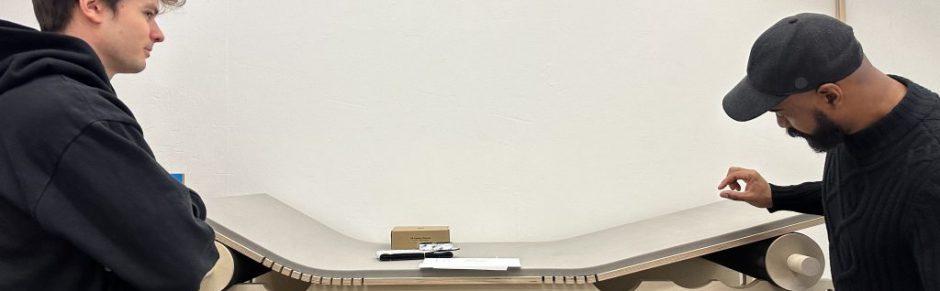
On 18 November 2025 I carried out the intervention in four forum groups in person. As has been the case in the usual formative way, the students stayed physically together, showed their developing work and received feedback from both the tutors and their fellow students. At the same time Microsoft Teams was used so that the spoken discussion could produce real-time captions and a transcript. This was important from a methodological standpoint since I was not replacing the forum with an online activity but was instead adding a digital record to the existing studio practice.
What I documented
The intervention produced a variety of data, including the four forum transcripts, the responses to the questionnaire and my personal observations of the process. I made screenshots and photographs in order to keep a record of the practical setup. These records served as evidence of how the intervention worked in real circumstances, illustrating the kind of usual problems that occur with devices, microphones, screens and taking turns. I considered the practical elements to be an integral part of the research rather than something irrelevant, since a workflow which is technically inconvenient or distracting is unlikely to developinto a sustainable teaching practice.
Early reflexive observations
Two observations provided useful starting points for the cycle in question, even though I am not considering either of them as a finding. The first of these was that at the beginning of the experiment I had asked the students to place their phones visibly on the table in order to reduce scrolling and make attention more apparent. However, on reflection I wondered whether a rule requiring devices to be visible might also have had the effect of normalising the declaration of assistive functions such as translation or taking personal notes. Since I had not measured this effect, it remains a practitioner hypothesis.
The second observation was when a student demonstrated the PowerPoint Live translation feature through Teams. I was able to see the feature in operation, but I did not evaluate its reliability, the impact it had on learning or the policy implications it might have in this study. It must therefore be dealt with in future practice rather than being included in the findings.
Preparing for analysis
The phase in which the data were collected altered the focus of the project. At the start I asked whether recording and transcribing could preserve feedback; by the time the implementation was completed I was posing a more conditional question—that is, under what circumstances does a record which can be revisited actually improve access without leading to greater surveillance, distraction or workload? This change in direction influenced the later analysis of the questionnaire, the formulation of the interview questions and the thematic work. It also enabled me to distinguish three things which had earlier been confused: what the intervention in fact produced, how I interpreted those observations, and what I wished to test next.

References
Allen, A. (2025) Student Test Forum transcripts, 18 November 2025. Unpublished Action Research Project data.
University of the Arts London (UAL) (2024) Supporting Inclusive and Developmental Crits: Guidance for Staff. London: UAL.
British Educational Research Association (BERA) (2024) Ethical Guidelines for Educational Research. 5th edn. London: BERA.
Braun, V. and Clarke, V. (2022) Thematic Analysis: A Practical Guide. London: SAGE.
Focus Group Debrief Transcript (2025) – Students on recording comfort (unpublished ARP data).
Braun & Clarke (2006) – Thematic analysis method (for coding students’ open comments).
UAL (2024) Inclusive Crits Guidance – emphasis on student agency and safety.