Blog Post 2: Lisa × Safie Sustainability Workshop
Introduction
This reflective post examines a material-first design workshop and lecture on Materiality and sustainability, designed and developed by alumna Luisa Kahlfeldt and Safie Pluck, Lecturer in Product Design and studio Tutor. I co-facilitated the workshop session and joined the lecture on the day for Stage 3 Product and Industrial Design students.
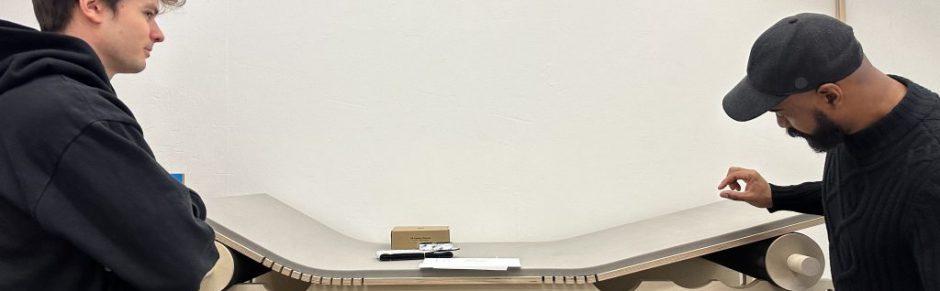
Workshop and Lecture,” the session was a deep dive into sustainable materials, Luisa’s practice development and design practices. Luisa Kahlfeldt (an alumna of our program known for her sustainable material innovations and product SUMO) and Safie Pluck (a practicing sustainable designer and studio tutor on Ba Product and industrial design) led the workshop. At the same time, I assisted with facilitating group activities and discussions. The focus was explicitly material-first: instead of starting from form or function, students began by hands-on exploration of sustainable materials – ranging from biodegradable textiles to natural technical fibres and composites – and let these materials inspire design ideas. This approach was meant to instil the importance of materials in achieving sustainability outcomes. In this introduction, I set the context of the workshop and my role, preparing to reflect on its impact and pedagogical implications, especially concerning learning from near-peers (alumni and peers) and learning through making.
The structure of the workshop combined tactile engagement, material research, idea generation, rapid prototyping and material board group creation. In the morning after the lecture, student teams visited a table where they could touch, explore and receive information on various sustainable materials that Luisa had brought from her professional work. The students then built large pin-up collage boards, one per group, that helped them visually and contextually build a group direction.
Reflection
Learning from nearer to-peer inspiration Alumni: A striking aspect of this workshop was the affective impact of having an alumna (Luisa Kahlfeldt) co-facilitate. Students were visibly intrigued and inspired by hearing Luisa’s journey from being a student in our program to becoming a designer known for sustainable materials innovation. As she shared her portfolio and described how she founded her company around a material-first ethos. This was a tangible role model effect. Educational research underscores the value of alumni or near-peer mentors in teaching: they are relatable and can significantly enhance students’ perceived learning because of that relatability
In fact, a recent study by Phan et al. (2024) found that alumni guest speakers “significantly enhance students’ perceived learning outcomes and communication skills because of their relatability and personal insights.”
My reflection on my own facilitation reveals that I, too, was learning and benefiting. Assisting in a primarily student-driven workshop (with external facilitators) allowed me to practice a more Socratic coaching style – a key idea in constructivist pedagogy is that learners construct knowledge through overcoming challenges with guidance (Bruner, 1961). The workshop reinforced my belief that as an educator, stepping back and letting students get their hands dirty (literally, in this case) can be far more beneficial than my delivering polished content. The workshop’s tactile, messy learning process embodied a quote by educational theorist Paulo Freire: “Knowledge emerges only through invention and re-invention, through the restless, impatient, continuing, hopeful inquiry [learners] pursue in the world, with the world, and with each other.” Here, the inquiry was very much with the world of materials and with each other in groups.
Conclusion
Reflecting on the Lisa × Safie Sustainability Workshop, I find it was a rich learning experience that reinforced several key pedagogical insights for me. Firstly, the value of alumni (nearer-peer) engagement in teaching was powerfully affirmed. Hearing and working alongside an alumna practitioner provided students with inspiration, relatable role modelling, and practical career-linked knowledge. It created an aspirational bridge between the academic and professional worlds. I plan to continue involving alumni in my teaching practice – whether through workshops, guest critiques, or mentorship programs – as the resonance it has with students is profound and supported by research on student motivation.
References
- Bandura, A. (1977). Social Learning Theory. New York: General Learning Press.
- Burns, H. (2013). Meaningful sustainability learning: A study of sustainability pedagogy in two university courses. International Journal of Teaching and Learning in Higher Education, 25(2), 166-175.
- Karana, E., Blauwhoff, D., Hultink, E.J., & Kamp, J. (2015). When Material Matters: Developing Materials-Driven Design Approach. International Journal of Design, 9(2), 35-54.
- Kolb, D. (1984). Experiential Learning: Experience as the Source of Learning and Development. Englewood Cliffs, NJ: Prentice Hall.
- Phan, T.A., Vu, T.H.N., Vo, N.T.N., & Le, T.H. (2024). Enhancing Educational Outcomes Through Strategic Guest Speaker Selection: Alumni vs Industry Experts. Business and Professional Communication Quarterly, 87(1), 56-70.
- Sterling, S. (2004). Higher Education, Sustainability, and the Role of Systemic Learning. In P.B. Corcoran & A.E.J. Wals (Eds.), Higher Education and the Challenge of Sustainability (pp. 49-70). Springer.
- Van Bezooyen, A. (2013). Material Stories: Design Fiction in Support of Sustainable Materials Development. In Proceedings of Materials and Design Conference (pp. 277-286).
- Wenger, E. (1998). Communities of Practice: Learning, Meaning, and Identity. Cambridge: Cambridge University Press.
