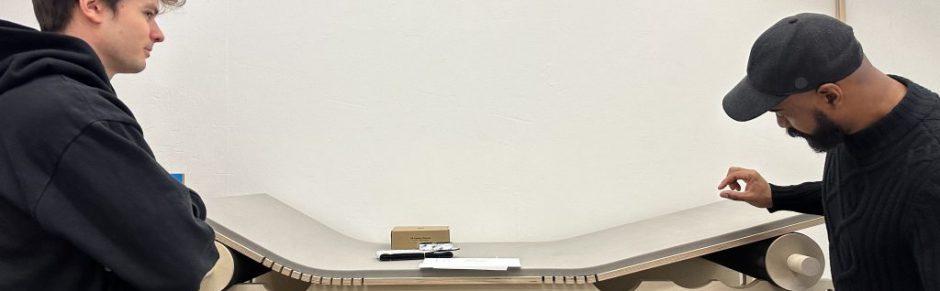
The Race
Unequal starting lines
“When we line up to race, is this a fair starting line? ‘Nope.’” (Channel 4 2020)
The Year-7 “privilege walk” from The School That Tried to End Racism still echoes in my crit room at Central Saint Martins: talent strides out from staggered blocks, yet our assessment rubrics pretend everyone began level.
Evidence and counterevidence
Critical Race Theory shows how apparently neutral data preserve advantage. Bradbury’s study of England’s Baseline Assessment records a policy that “failed to take into account the needs of bilingual learners… continuing white dominance while appearing meritocratic” (Bradbury 2020, p. 244) and reminds us that “numbers are not neutral and should be interrogated for their role in promoting deficit analyses” (p. 246).
Up the pipeline, Garrett’s interviewees describe racialised PhD students watching “racialised academics being overlooked for promotions and undervalued for their roles as mentors” (Garrett 2024, p. 8), which is hardly enticing when only a wafer-thin fraction of professors look like them.
Corporate quick fixes rarely help. Asif Sadiq notes that “Eight billion dollars were spent on diversity training last year, and we’re still talking about the same problems” (Sadiq 2023, 07:12) because the training itself is “built with stereotypes… and many times does the very opposite of inclusion” (09:36).
Yet the backlash casts anti-racism as ideology. In a Telegraph documentary, Advance HE’s Race Equality Charter is branded a scheme that “incentivises university leaders to wire into… institutions a vision vast swathes of the public would reject” (Orr 2022, 01:55); implicit-bias workshops are dismissed because they “really don’t work” (05:18) and are said to chill free speech. Bradbury’s CRT analysis supplies the empirical rebuttal: assessment reforms routinely “re-introduce the Black/White achievement gap” when equity is ignored (Bradbury 2020, p. 247). Data, not dogma, exposes the gap between excellence rhetoric and inequitable practice.
Locating myself
I write as a Black British Stage Lead and Senior Lecturer (Year 3 & 2 BA Product & Industrial Design, CSM). My vantage point straddles lived experience and institutional responsibility: my own practice once celebrated “merit” while overlooking who the brief centred, who the prototype fitted and whose voice the viva privileged. Decolonial design asks us to design from the margins inwards, and Sadiq’s call for “experiential discomfort” legitimises bringing structured unease into the studio. If students do not feel inequity, as those Year-7s did, they will sketch it again into tomorrow’s products.
Towards equitable futures
Institutional shift: keep the Charter but tie any award to demonstrable narrowing of awarding and progression gaps, not merely written action plans.
Curricular tweak: start the Projects with a privilege-mapping sprint – students redraw stakeholder hierarchies and must evidence how their prototypes redistribute benefit. This could benefit all marginalised stakeholder positions and help build better design.
Personal practice: replace one traditional crit each term with peer-storytelling sessions led by racialised students; publish and sign post the feedback rubric regularly and link and explain how they map to the Key LO’s to surface hidden expectations and help students and teachers feel out, not only the why of this process but help all practice how they might process this complexity in meaning full way.
Design education cannot disclaim politics: every policy draft, project brief or hiring panel either flattens the starting line or tilts it further. By interrogating data through CRT and foregrounding embodied classroom experience, we turn the Race Equality Charter from a perceived threat to excellence into a litmus test of what genuine excellence and progress now demands.
References
Bradbury, A. (2020) ‘A critical race theory framework for education policy analysis: the case of bilingual learners and assessment policy in England’, Race Ethnicity and Education, 23(2), pp. 241–260.
Channel 4 (2020) Heartbreaking Moment When Kids Learn About White Privilege | The School That Tried to End Racism. YouTube video, 30 June. Available at: https://www.youtube.com/watch?v=1I3wJ7pJUjg (Accessed: 08 June 2025).
Garrett, R. (2024) ‘Racism shapes careers: career trajectories and imagined futures of racialised minority PhDs in UK higher education’, Globalisation, Societies and Education, pp. 1–15 (ahead of print).
Orr, J. (2022) Revealed: The Charity Turning UK Universities Woke. YouTube video, 5 August. Available at: https://www.youtube.com/watch?v=FRM6vOPTjuU (Accessed: 08 June 2025).
Sadiq, A. (2023). Diversity, Equity & Inclusion: Learning How to Get It Right. YouTube video, 2 March. Available at: https://www.youtube.com/watch?v=HR4wz1b54hw (Accessed: 08 June 2025).

Emily Cornuaud’s Empathy Lines, designed for Cumberland School in Summer 2022, has been painted onto the grounds of this Community School for use by students and teachers in 2023. Emily Cornuaud Graduated from BAPID CSM in 2022.
Spatial Physical Group activities can help all involved imagine the differences that they may not be aware of.
The project was co-created and designed with staff and students at the Primary school she attended as a child. This project was her Stage 3 Collaborative project with Clear Channel.